
You have no items in your shopping cart.
VDAC3 Antibody (Center)
SKU: orb1934339
Description
Research Area
Cell Biology, Metabolism Research, Signal Transduction
Images & Validation
−Item 1 of 7
| Tested Applications | FC, IHC-P, WB |
|---|---|
| Dilution Range | WB - 1:1000 |
| Reactivity | Human, Mouse, Rat |
| Predicted Reactivity | Bovine, Porcine, Rabbit |
Key Properties
−| Antibody Type | Primary Antibody |
|---|---|
| Host | Rabbit |
| Clonality | Polyclonal |
| Isotype | Rabbit IgG |
| Molecular Weight | 30659 Da |
| Conjugation | Unconjugated |
Storage & Handling
−| Storage | Maintain refrigerated at 2-8°C for up to 2 weeks. For long term storage store at -20°C in small aliquots to prevent freeze-thaw cycles |
|---|---|
| Form/Appearance | Purified polyclonal antibody supplied in PBS with 0.09% (W/V) sodium azide. This antibody is purified through a protein A column, followed by peptide affinity purification. |
| Expiration Date | 12 months from date of receipt. |
| Disclaimer | For research use only |

Quality Guarantee
Explore bioreagents carefree to elevate your research. All our products are rigorously tested for performance. If a product does not perform as described on its datasheet, our scientific support team will provide expert troubleshooting, a prompt replacement, or a refund. For full details, please see our Terms & Conditions and Buying Guide. Contact us at [email protected].
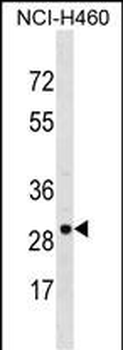
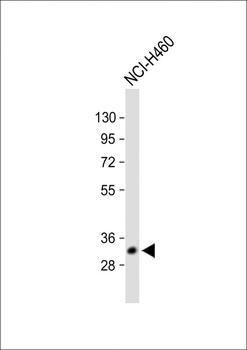
VDAC3 Antibody (Center) western blot analysis in NCI-H460 cell line lysates (35 ug/lane). This demonstrates the VDAC3 antibody detected the VDAC3 protein (arrow).
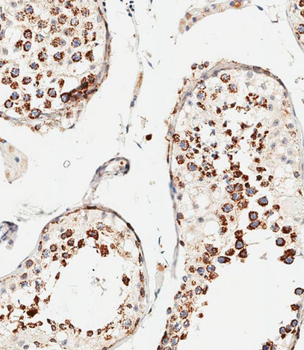
Immunohistochemical analysis of paraffin-embedded human testis tissue was performed on the Leica BOND RXm. Samples were incubated with primary antibody (1/500) for 1 hours at room temperature. A undiluted biotinylated CRF Anti-Polyvalent HRP Polymer antibody was used as the secondary antibody.
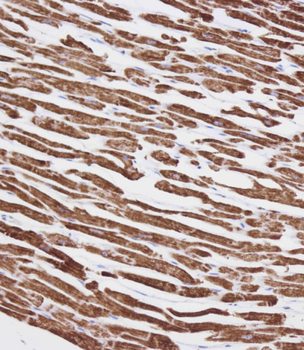
Immunohistochemical analysis on paraffin-embedded Human heart tissue. Tissue was fixed with formaldehyde at room temperature. Heat induced epitope retrieval was performed by EDTA buffer (pH9.0). Samples were incubated with primary antibody (1:100) for 1 hour at room temperature. Undiluted CRF Anti-Polyvalent HRP Polymer antibody was used as the secondary antibody.
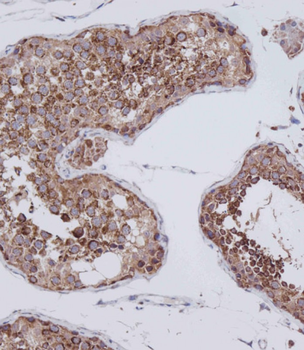
Immunohistochemical analysis on paraffin-embedded Human testis tissue. Tissue was fixed with formaldehyde at room temperature. Heat induced epitope retrieval was performed by EDTA buffer (pH9.0). Samples were incubated with primary antibody (1:100) for 1 hour at room temperature. Undiluted CRF Anti-Polyvalent HRP Polymer antibody was used as the secondary antibody.
All lanes: Anti-VDAC3 Antibody (Center) at 1:1000 dilution. Lane 1: Human heart lysate. Lane 2: NCI-H460 whole cell lysate. Lane 3: A431 whole cell lysate. Lane 4: U-2OS whole cell lysate. Lane 5: Mouse testis lysate. Lane 6: Rat brain lysate. Lysates/proteins at 20 µg per lane. Secondary Goat Anti-Rabbit IgG, (H+L), Peroxidase conjugated at 1/10000 dilution. Predicted band size: 31 kDa. Blocking/Dilution buffer: 5% NFDM/TBST.
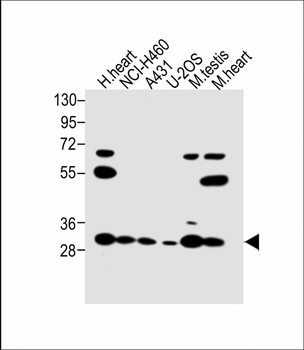
All lanes: Anti-VDAC3 Antibody (Center) at 1:1000 dilution. Lane 1: Human heart lysate. Lane 2: NCI-H460 whole cell lysate. Lane 3: A431 whole cell lysate. Lane 4: U-2OS whole cell lysate. Lane 5: Mouse testis lysate. Lane 6: Mouse heart lysate. Lysates/proteins at 20 µg per lane. Secondary Goat Anti-Rabbit IgG, (H+L), Peroxidase conjugated at 1/10000 dilution. Predicted band size: 31 kDa. Blocking/Dilution buffer: 5% NFDM/TBST.
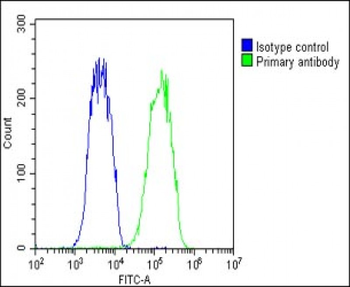
Overlay histogram showing Hela cells stained (green line). The cells were fixed with 2% paraformaldehyde (10 min) and then permeabilized with 90% methanol for 10 min. The cells were then icubated in 2% bovine serum albumin to block non-specific protein-protein interactions followed by the antibody (1:25 dilution) for 60 min at 37°C. The secondary antibody used was Goat-Anti-Rabbit IgG, DyLight 488 Conjugated Highly Cross-Adsorbed at 1/200 dilution for 40 min at 37°C. Isotype control antibody (blue line) was rabbit IgG1 (1 μg/1x10^6 cells) used under the same conditions. Acquisition of > 10000 events was performed.
Quick Database Links
UniProt
UniProt Details
− No UniProt data available
Documents Download
Datasheet
Product Information
Request a Document
Protocol Information
WB
Western Blot (IB, immunoblot)
IHC-P
Immunohistochemistry Paraffin
FC
Flow Cytometry
VDAC3 Antibody (Center) (orb1934339)

- 0.0
Based on 0 reviews
Participating in our Biorbyt product reviews program enables you to support fellow scientists by sharing your firsthand experience with our products.
Login to Submit a ReviewAvailable Sizes
Select a size below
 Usually dispatched within 5-10 working days