
You have no items in your shopping cart.
Immunology & Assay Development
Antibodies: Why Chicken IgY?
Understanding the structural differences, evolutionary advantages, and practical laboratory applications of avian antibodies.
Immunoglobulin Y (IgY) is the dominant immunoglobulin found natively in avian, amphibian, and reptilian species. It serves as the primary immune defense, functionally equivalent to mammalian IgG.
In 1893, Felix Klemperer1 first described the foundational concept of passive immunity by scientifically reporting the presence and physical transference of tetanus toxin immunity (antibodies) from a hen directly to a chick via the egg. He importantly noted that active antibodies were present in both the circulating blood of the chicken and the yolk of the egg that it laid.
However, it wasn’t until 1969 that Leslie and Clem2 officially coined the modern term IgY to accurately describe poultry antibodies, explicitly including those found abundantly in the yolk of the eggs. Until 1969, IgY was biologically known and widely reported as "IgG", but the structural and antigenic differences were ultimately shown to be great enough to rightfully earn the unique protein the new Immunoglobulin classification IgY.
1. Structural Comparison: IgG vs IgY
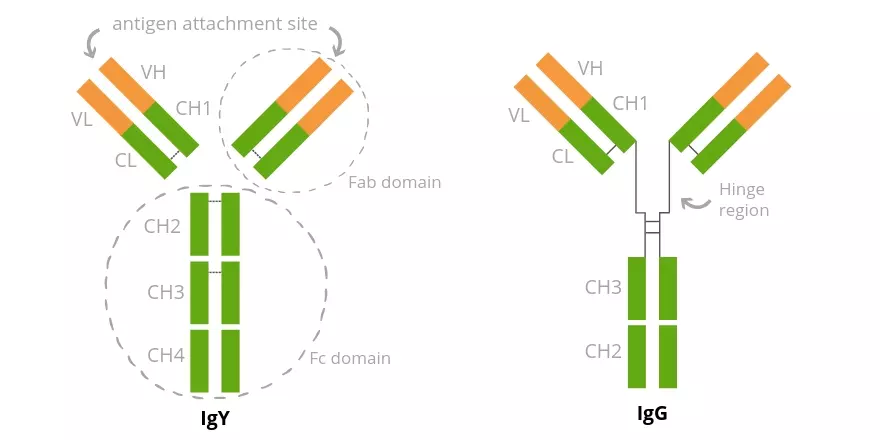
(Figure 1) Avian IgY structure, compared directly to mammalian IgG. Both contain two heavy and two light chains, which consist of a variable domain (VH and VL) and four constant domains (CH1, CH2, CH3 and CH4). IgG possesses a longer hinge region, making it physically more flexible than avian IgY.
How are they similar?
IgG and IgY share several critical biological characteristics:
- Both possess the characteristic, highly recognizable antibody "Y" shape.
- Both fundamentally contain 2 heavy chains and 2 light chains.
- Both are structurally divalent (possessing two distinct antigen-binding sites).
- Both play a highly similar biological role, serving as the major immunoglobulins to provide robust, long-term defense against infectious agents, typically appearing in high systemic concentrations after the initial acute synthesis of the higher molecular weight antibody (IgM).
How are they different?
The structural and immunological variations are distinct:
- There is little or no immunological cross-reactivity between avian IgY and mammalian IgG.
- IgY possesses a higher overall molecular weight due directly to the presence of an extra heavy chain constant domain.
- IgY completely lacks a well-defined, flexible hinge region.
- IgY heavy chains lack specific mammalian Fc domains, meaning they do not fix mammalian complement or successfully bind protein A or protein G.
- IgY can naturally facilitate systemic anaphylactic reactions, a function which can only be biologically performed by IgE in mammals.
An Evolutionary Ancestor?
IgY also heavily shares some distinct similarities with mammalian IgE, including highly similar intrachain disulfide bonding within their extra heavy chain domain. This unique structural overlap led early scientists to strongly suggest that IgY may well be a direct evolutionary ancestral molecule to both mammalian IgG and IgE, an elegant hypothesis which has since been thoroughly confirmed by rigorous genetic and structural studies.3 4 5
2. Advantages of IgY in Research
Given these distinct differences and deep similarities, why would you want to actively use IgYs in your laboratory research? The very fact that the molecules are so highly similar in both their biological role and their basic structure, yet different enough to absolutely not cross-react, securely offers several massive advantages to a modern research scientist.
In most standard experimental applications, safely including Western blotting, immunohistochemistry, immunocytochemistry, ELISA, and functional blocking experiments, both IgG and IgY are functionally equivalent, meaning IgY can generally be used as a highly effective, direct alternative to IgG.5
Key Laboratory Advantages:
Higher Avidity
Chickens are not mammals, so their innate immunological reaction to a mammalian antigen is heavily enhanced, leading directly to the production of exceptionally high-avidity antibodies. The immune response is particularly strong to mammalian antigens and especially those which are highly genetically conserved across mammalian species.
Humane & High Yield
What could possibly be more humane? The chicken naturally lays the egg, so there is absolutely no need to bleed or otherwise conduct invasive procedures on the animal; researchers simply collect the eggs. Additionally, one chicken can successfully produce massively large quantities of IgY against very low quantities of injected antigen. Some healthy hens can produce 2.5 - 3 grams of IgY per month, which is 10-20 times the total amount produced by a laboratory rabbit.6
Lower Background Noise
IgY inherently does not bind to mammalian IgG Fc receptors, meaning you get significantly less false-positive background staining in tissue sections. Furthermore, they do not accidentally activate mammalian complement systems in complex assays.
Ideal for Multiplexing
Because there is zero cross-reactivity to mammalian species, IgY antibodies make an absolutely excellent, reliable addition to complex multiple labeling or multi-plex fluorescent experiments.
- Quick Production: Compared to rabbits, you can efficiently obtain highly concentrated, high-titer antibody directly from eggs as early as day 25 post-immunization.
- Convenient Storage: IgY is packed neatly in native eggs, which can be safely stored in the cold for long periods and the IgY safely purified to the desired titer/avidity many months later.
- Versatile Functionality: IgY can still be efficiently digested by papain to successfully produce a divalent Fab fragment. It can also be easily conjugated to enzymes (HRP/AP) or fluorophores, biotinylated, and gold-labeled by standard protocols, offering you the full robust range of functionality you would expect from a premium antibody tool.
3. References
- Klemperer, F. Ueber natürliche Immunität und ihre Verwerthung für die Immunisirungstherapie. Arch. Für Exp. Pathol. Pharmakol. 31, 356–382 (1893). Link
- Leslie, G. A. & Clem, L. W. Phylogeny of immunoglobulin structure and function. 3. Immunoglobulins of the chicken. J. Exp. Med. 130, 1337–1352 (1969). Link
- Zhang, X., Calvert, R. A., Sutton, B. J. & Doré, K. A. IgY: a key isotype in antibody evolution: IgY antibody. Biol. Rev. 92, 2144–2156 (2017). Link
- Taylor, A. I., Fabiane, S. M., Sutton, B. J. & Calvert, R. A. The Crystal Structure of an Avian IgY-Fc Fragment Reveals Conservation with both Mammalian IgG and IgE. Biochemistry 48, 558–562 (2009). Link
- Lee, W., Syed Atif, A., Tan, S. C. & Leow, C. H. Insights into the chicken IgY with emphasis on the generation and applications of chicken recombinant monoclonal antibodies. J. Immunol. Methods 447, 71–85 (2017). Link
- Amro, W. A., Al-Qaisi, W. & Al-Razem, F. Production and purification of IgY antibodies from chicken egg yolk. J. Genet. Eng. Biotechnol. 16, 99–103 (2018). Link