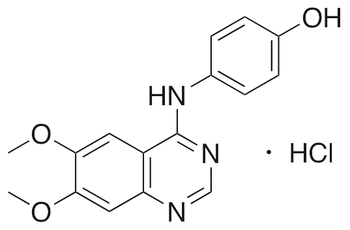
JANEX-1 is administered in doses from 5 to 100 mg/kg, showing a dose-response relationship with an ED50 of 7.44 mg/kg, significantly reducing CPK and LDH levels in mice. These mice also exhibit a notably smaller infarct size (30.16±2.79%) compared to I/R-operated mice (65.64±3.76%). JANEX-1, also known as WHI-P131, is quickly absorbed, reaching peak plasma concentration in roughly 24.7±1.7 minutes, and has a short elimination half-life of 45.6±5.5 minutes. Despite the maximum plasma concentration being only half of what is observed with intravenous (i.v.) administration at the same dose, intraperitoneal (i.p.) bioavailability stands at 94.6%, with systemic exposure levels (AUC) closely matching those seen after i.v. injection (17.1±2.2 μM·h versus 18.1±1.2 μM·h).
In Vitro
JANEX-1 (WHI-P131) exhibits strong inhibitory activity against JAK3 with an IC50 value of 78 μM, while showing no inhibitory effects on JAK1, JAK2, and various tyrosine kinases including SYK, BTK, LYN, and the insulin receptor kinase, even at concentrations up to 350 μM. It specifically induces apoptosis in human leukemia cell lines expressing JAK3 (NALM-6 and LC1;19) without affecting melanoma (M24-MET) or squamous carcinoma (SQ20B) cells. Furthermore, WHI-P131 effectively suppresses the clonogenic growth of several JAK3-positive leukemia cell lines (DAUDI, RAMOS, LC1;19, NALM-6, MOLT-3, and HL-60) in a concentration-dependent manner, with EC50 values of 24.4 μM and 18.8 μM for NALM-6 and DAUDI cells respectively, achieving more than 99% inhibition of colony formation at 100 μM. However, it does not impede the clonogenic proliferation of JAK3-negative cancer cell lines such as BT-20 breast cancer, M24-MET melanoma, or SQ20B squamous carcinoma.
Cell Research
JANEX-1 (WHI-P131) is dissolved in DMSO and stored, and then diluted with appropriate media (DMSO 0.1%) before use. The following cell lines are used in various biological assays: NALM-6 (pre-B-ALL), LC1;19 (pre-B-ALL), DAUDI (B-ALL), RAMOS (B-ALL), MOLT-3 (T-cell ALL), HL60 (acute myelogenous leukemia), BT-20 (breast cancer), M24-MET (melanoma), SQ20B (squamous cell carcinoma), and PC3 (prostate cancer). These cell lines are maintained in culture. Cells are seeded in six-well tissue culture plates at a density of 50×104 cells/well in a treatment medium containing various concentrations of JANEX-1 (0.1, 0.2, 0.3, 0.4 and 0.5 nM) and incubated for 24-48 h at 37°C in a humidified 5% CO2 atmosphere. Cells are examined for apoptotic changes after treatment with JANEX-1 by the in situ TdT-mediated dUTP end-labeling assay using the ApopTag apoptosis detection kit.
Explore bioreagents carefree to elevate your research. All our products are rigorously tested for performance. If a product does not perform as described on its datasheet, our scientific support team will provide expert troubleshooting, a prompt replacement, or a refund. For full details, please see our Terms & Conditions and Buying Guide. Contact us at [email protected].



 Usually dispatched within 3-5 working days