Cart summary

You have no items in your shopping cart.

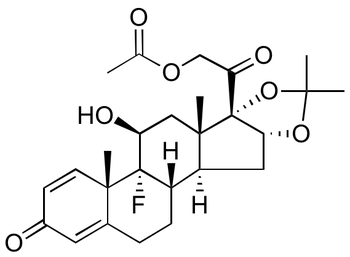
Triamcinolone acetonide

SKU: orb1310263

Description

Triamcinolone acetonide (Azmacort) is a synthetic glucocorticoid that acts as a corticosteroid receptor agonist, primarily used for its potent anti-inflammatory effects. It is widely applied in research models of dermatological, allergic, and autoimmune conditions, both in vitro for receptor studies and in vivo for evaluating anti-inflammatory efficacy.

Research Area

Cardiovascular Research, Metabolism Research, Signal Transduction

Images & Validation

Key Properties

CAS Number76-25-5
MW434.50
Purity99.91%
FormulaC24H31FO6
SMILESC(CO)(=O)[C@]12[C@]3(C)[C@@](C[C@]1(OC(C)(C)O2)[H])([C@]4([C@](F)([C@@H](O)C3)[C@]5(C)C(CC4)=CC(=O)C=C5)[H])[H]
TargetFGFR,Glucocorticoid Receptor
SolubilityEthanol:13 mg/mL (29.92 mM);DMSO:50 mg/mL (115.07 mM);10% DMSO+40% PEG300+5% Tween 80+45% Saline:2 mg/mL (4.6 mM)

Bioactivity

In Vivo
Triamcinolone Acetonide reduced polysaccharide synthesis and increased the glycosaminoglycan (GAG) content in the culture medium compared to the blank group and IL-1 group. It also augmented GAG degradation. This compound significantly decreased the paracellular permeability of ECV304 cells and downregulated ICAM-1 expression, corroborating with immunocytochemical observations. In rat retinas, Triamcinolone reversed Müller glial cell swelling, a phenomenon observed under various experimental conditions: in retinas isolated 3 days post-transient retinal ischemia, in control retinas with 1 mM Ba^2+, 10 μM arachidonic acid, 200 μM H2O2, or 30 nM prostaglandin E2, and in retinas with lipopolysaccharide-induced ocular inflammation.
In Vitro
In horses subjected to a second injection of lipopolysaccharide, Triamcinolone Acetonide reduced edema, lameness, and joint fluid protein concentration. In mice, Triamcinolone Acetonide, a synthetic glucocorticoid, induced cleft palate resulting from impaired palatal development. In the jaws of rat embryos, Triamcinolone Acetonide inhibited the proliferation of mesenchymal cells and affected the differentiation of MEE (Medial Edge Epithelium) cells into stratified squamous epithelial cells. Compared to methoxycarbonyl alone, Triamcinolone Acetonide increased both the white blood cell count and methoxycarbonyl concentration in the synovial fluid.

Storage & Handling

StoragePowder: -20°C for 3 years | In solvent: -80°C for 1 year | Shipping with blue ice/Shipping at ambient temperature.
Expiration Date12 months from date of receipt.
DisclaimerFor research use only

Alternative Names

inhibit, Inhibitor, GlucocorticoidReceptor, Glucocorticoid Receptor, Azmacort, Aristoderm, Aristogel, Triamcinolone acetonide

Similar Products

Quality Guarantee

Quality Guarantee

Explore bioreagents carefree to elevate your research. All our products are rigorously tested for performance. If a product does not perform as described on its datasheet, our scientific support team will provide expert troubleshooting, a prompt replacement, or a refund. For full details, please see our Terms & Conditions and Buying Guide. Contact us at [email protected].

Key Properties

No computed properties available.

Documents Download

Datasheet
Product Information
Download

Request a Document

Protocol Information

Triamcinolone acetonide (orb1310263)

  • Star
  • Star
  • Star
  • Star
  • Star
  • 0.0
Based on 0 reviews

Participating in our Biorbyt product reviews program enables you to support fellow scientists by sharing your firsthand experience with our products.

Login to Submit a Review

No reviews yet

Step 1: Enter information below

(Recommended: An additional animal making an allowance for loss during the experiment)

Step 2: Enter the in vivo formulation

(This is only the calculator, not formulation. Please contact us first if there is no in vivo formulation at the solubility Section.)

% DMSO +
%+
% Tween 80 +
%

Available Sizes

Select a size below

50 mg
¥ 910.00
1 ml x 10 mM (in DMSO)
¥ 1,170.00
DispatchUsually dispatched within 3-5 working days
Bulk Enquiry